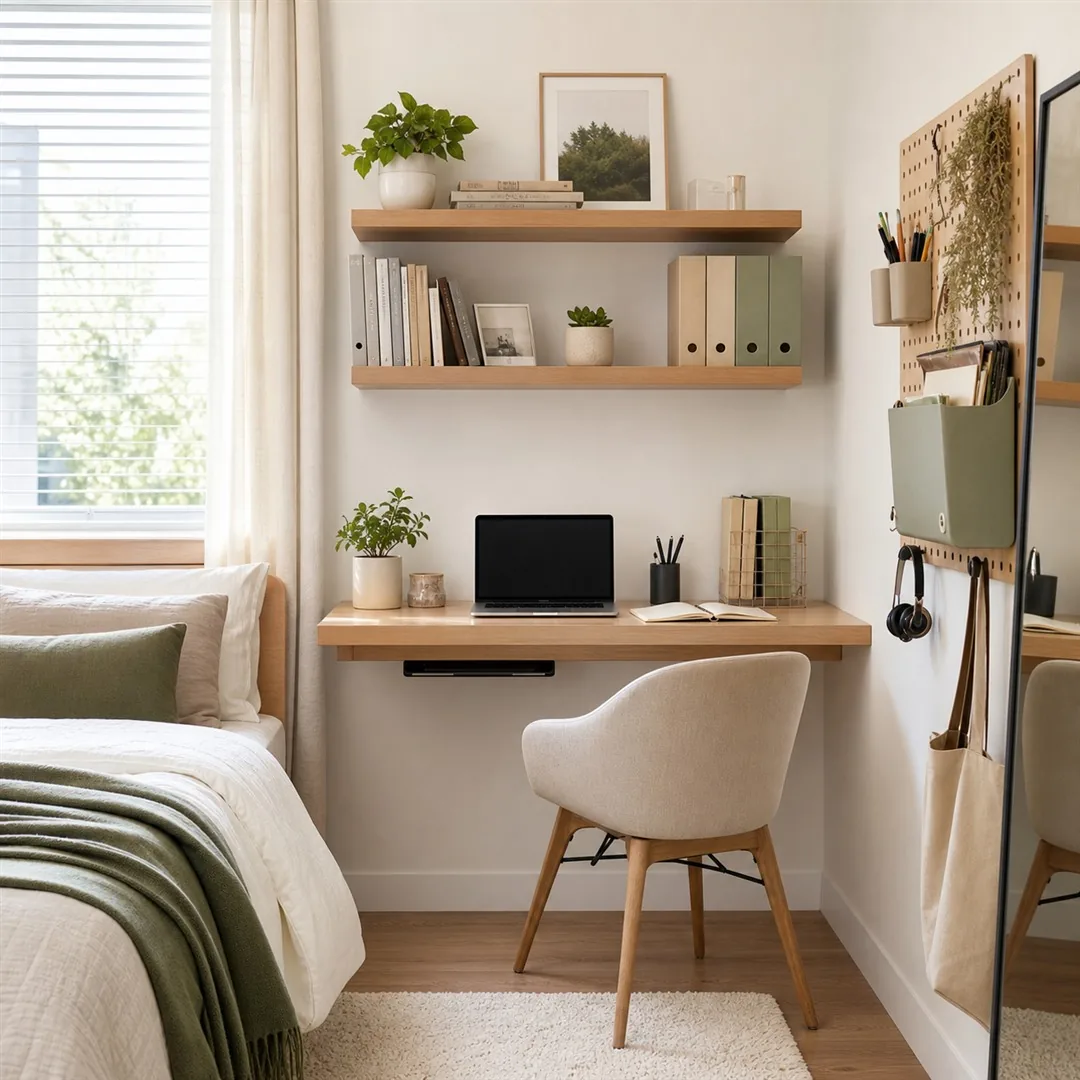
A cluttered desk in a small bedroom does more than look messy — it steals square footage, breaks your focus, and makes an already tight room feel smaller. The fix isn't a bigger desk. It's smarter organization: vertical storage, multi-purpose furniture, cable management, and a layout that respects how little floor space you actually have.
This guide walks through every practical way to organize a desk in a small bedroom, from $10 fixes to full furniture swaps, so you can pick what fits your space, budget, and habits.
If you only have five minutes, start here:
- Go vertical — wall shelves, pegboards, and stacking trays free up desk surface without using floor space.
- Choose a corner or floating desk — corners are dead space in most bedrooms; a floating desk needs zero legroom underneath for storage.
- Manage cables first — a cable tray or clips under the desk instantly reduces visual clutter.
- Use drawer dividers — small drawers hold more when items aren't loose and sliding around.
- Add a desktop organizer caddy — corrals pens, chargers, and sticky notes into one footprint instead of five.
- Keep only daily-use items on the surface — everything else goes in a drawer, bin, or off-site storage.
Each of these is explained in depth below, with product types, layouts, and mistakes to avoid.
Table of Contents
- Why Desk Organization Matters More in a Small Bedroom
- Step 1: Pick the Right Desk for a Small Bedroom
- Step 2: Use Vertical Space Instead of Desk Surface
- Step 3: Manage Cables Before Anything Else
- Step 4: Sort Everything Into Zones
- Step 5: Use Drawer Organizers and Dividers
- Step 6: Choose Multi-Purpose Furniture
- Step 7: Keep the Desktop Minimal
- Step 8: Use Lighting to Free Up Space
- Small Bedroom Desk Layout Examples
- Seasonal and Long-Term Desk Maintenance
- Common Desk Organization Mistakes in Small Bedrooms
- Frequently Asked Questions
- Key Takeaways
Why Desk Organization Matters More in a Small Bedroom
A small bedroom desk does triple duty — workspace, storage, and sometimes a vanity or gaming station. When that single surface gets overloaded, three things happen:
- Visual clutter raises stress. Research on environmental psychology consistently links cluttered workspaces to higher reported stress and reduced ability to focus.
- Lost space compounds. In a small room, every square foot a messy desk "borrows" from walking space or bed access makes the whole room feel tighter.
- Sleep quality can suffer. When a desk is the first and last thing you see, an untidy one can keep your mind on unfinished tasks instead of winding down.
The goal of desk organization in a small bedroom isn't just tidiness — it's reclaiming both physical space and mental bandwidth.
Step 1: Pick the Right Desk for a Small Bedroom
Before organizing what's on the desk, make sure the desk itself is suited to a small room. The wrong desk shape wastes space no organizer can fix.
Best Desk Types for Small Bedrooms
| Desk Type | Best For | Space Saved |
|---|---|---|
| Floating wall-mounted desk | Rooms under 100 sq ft | No legs, no floor footprint |
| Corner desk | L-shaped rooms with an unused corner | Uses "dead" corner space |
| Ladder desk with shelves | Renters who want built-in vertical storage | Combines desk + shelving in one footprint |
| Foldable/wall-mounted drop-leaf desk | Multi-purpose rooms (guest room, studio) | Folds flat when not in use |
| Narrow depth desk (under 20 inches) | Rooms where the desk sits along a wall | Keeps walkways clear |
Expert tip: Measure the walking path around your bed before buying a desk. If a drawer or chair can't fully open without hitting the bed, size down — a desk you can't comfortably use won't stay organized.
Step 2: Use Vertical Space Instead of Desk Surface
In a small bedroom, the wall above your desk is more valuable than the desk itself. Vertical storage keeps items accessible without eating into your work surface.
Vertical Storage Options
- Floating wall shelves above the desk for books, plants, or a printer.
- Pegboards for tools, headphones, chargers, and small containers that hook and rearrange easily.
- Wall-mounted grid panels for sticky notes, photos, and lightweight supplies.
- Stacking desktop trays for paperwork, mail, and notebooks — stacked vertically instead of spread flat.
- Monitor stands with storage underneath so the space beneath your screen holds pens or a phone instead of sitting empty.
Common mistake: Mounting shelves too high to reach without standing up. Keep daily-use vertical storage within arm's reach while seated — roughly 12–20 inches above the desk surface.
Step 3: Manage Cables Before Anything Else
Cables are the single biggest source of visible clutter on a small desk, and they're the easiest to fix.
How to Organize Desk Cables in a Small Bedroom
- Bundle cables with velcro ties instead of single-use zip ties, so you can adjust them later.
- Install an under-desk cable tray to lift the power strip and cords off the floor and out of sight.
- Label each cable at both ends with tape or cable tags, so unplugging one device doesn't mean tracing wires.
- Use a cable clip strip along the back edge of the desk to keep charging cables from falling behind furniture.
- Consolidate chargers with a single multi-port USB charging station instead of several separate wall adapters.
Why it matters: A desk can look "clean" and still feel chaotic if cables are visible. Hiding them is often the single highest-impact five-minute fix.
Step 4: Sort Everything Into Zones
Small desks work best when every item has one designated spot, grouped by how often you use it.
The Three-Zone Method
| Zone | What Goes Here | Where to Store It |
|---|---|---|
| Daily zone | Laptop, notebook, pen, phone stand | Desk surface |
| Weekly zone | Chargers, extra notebooks, headphones | Top drawer or desktop caddy |
| Rarely-used zone | Old cables, spare supplies, seasonal items | Under-bed storage or closet bin |
This mirrors a common professional organizing principle: if you use it daily, it stays on the surface; if you use it weekly, it goes in the nearest drawer; if you use it rarely, it leaves the desk area entirely. Applying this one rule eliminates most small-desk clutter within a single sorting session.
Step 5: Use Drawer Organizers and Dividers
An unorganized drawer is just clutter with a lid. Small drawers fill up fast, so dividers matter more in a small bedroom than in a large home office.
Best Drawer Organization Tools
- Adjustable drawer dividers to create custom compartments for pens, sticky notes, and small tools.
- Stackable drawer trays for two layers of storage in one shallow drawer.
- Small parts organizers (the kind used for craft supplies) for paper clips, USB drives, and chargers.
- Felt-lined jewelry-style trays repurposed for tech accessories to prevent scratching and sliding.
Best practice: Empty one drawer completely, wipe it down, and only put back items that fit a defined category. Anything left over gets relocated or discarded — don't force it back in.
Step 6: Choose Multi-Purpose Furniture
In a small bedroom, furniture that does one job is a luxury you may not have room for. Multi-purpose pieces solve organization and space problems simultaneously.
Multi-Purpose Desk Furniture Ideas
- Desk with built-in drawers instead of a separate filing cabinet.
- Storage ottoman as an extra seat that doubles as a place to stash notebooks or blankets near the desk.
- Bed frame with under-bed drawers to relocate rarely-used desk supplies out of the workspace entirely.
- Bookshelf-back desk (also called a "hutch" desk) to combine vertical storage with a work surface in one unit.
- Fold-down wall desk with a mounted shelf above for rooms where the desk needs to disappear when not in use.
Step 7: Keep the Desktop Minimal
Once cables, drawers, and vertical storage are sorted, the actual desk surface should hold very little.
What Should Stay on a Small Desk
- Laptop or monitor
- One pen/pencil holder
- A small notebook or planner
- A lamp (ideally a clip-on or wall-mounted one to save surface space)
- One small plant or personal item, if desired
What Should Be Removed From the Desktop
- Paperwork that isn't from today
- Extra chargers not in daily use
- Decorative items beyond one or two pieces
- Anything without a "home" — if it doesn't have a designated storage spot, it doesn't belong on the surface
Expert tip: Professional organizers often recommend the "one in, one out" rule for small surfaces — if you add a new item to the desk, something else has to leave it. This keeps the surface from slowly refilling after every organizing session.
Step 8: Use Lighting to Free Up Space
A bulky desk lamp can take up more room than people expect on a small surface.
- Clip-on lamps attach to the desk edge or a shelf, freeing the surface entirely.
- Wall-mounted swing-arm lamps eliminate the lamp base altogether.
- Under-shelf LED strip lighting lights the desk from above without using any surface space.
Small Bedroom Desk Layout Examples
Layout 1: The Corner Setup
A compact corner desk with a wall shelf above it and a pegboard on the adjacent wall. Best for rooms where the bed takes up most of the floor plan.
Layout 2: The Floating Desk Wall
A wall-mounted floating desk with two floating shelves above, an under-desk cable tray, and a rolling storage cart tucked beneath it that can slide out when needed and hide away otherwise.
Layout 3: The Multi-Purpose Nook
A desk with built-in drawers positioned beside a storage ottoman, using the ottoman as both a footrest and hidden storage for supplies.
Layout 4: The Fold-Down Wall Desk
A wall-mounted drop-leaf desk that folds flat when not in use, paired with a single shelf above it for a lamp and a small stack of books. Best for very small or multi-purpose rooms, such as a guest room that occasionally serves as an office, where floor space needs to be reclaimed at the end of the day.
Layout 5: The Rolling Cart Add-On
A narrow desk paired with a slim rolling cart tucked into the gap beside it. The cart holds printer paper, art supplies, or extra tech accessories and can be rolled out for access, then pushed back against the wall when not needed — useful in rooms where a fixed second storage piece won't fit.
Seasonal and Long-Term Desk Maintenance
Organizing a small desk once is easy. Keeping it organized is the harder part, especially in a room where the desk shares space with sleeping, dressing, and relaxing.
A Simple Weekly Reset
- Clear the desktop down to daily-use items only, every evening or once a week.
- File or recycle loose paperwork before it stacks up.
- Return anything borrowed from a drawer to its designated spot.
- Wipe down the surface — a clean desk is easier to keep clutter-free than a dusty one.
A Simple Monthly Deep Clean
- Empty every drawer and check whether the current dividers still make sense for what you're storing.
- Test every cable — if you can't identify what it charges or connects to, it's a candidate for removal.
- Reassess vertical storage — shelves and pegboards tend to accumulate decorative items that quietly crowd out functional ones.
- Ask, for each item on or near the desk, whether it has been used in the past month. If not, relocate it to under-bed or closet storage, or remove it from the room.
Why a recurring system matters: In a small bedroom, there's no spare surface for overflow. Without a regular reset, clutter has nowhere to go but back onto the desk. A five-minute nightly habit prevents the need for a bigger monthly overhaul.
Common Desk Organization Mistakes in Small Bedrooms
- Buying storage before decluttering. Adding bins to a desk full of things you don't need just organizes the clutter — it doesn't remove it.
- Choosing a desk that's too deep. A desk deeper than 24 inches in a small room often forces you to reach over clutter instead of clearing it.
- Ignoring vertical space. Flat surfaces fill up fast; walls rarely get used to their full potential.
- Not managing cables. Even a perfectly organized desk looks messy with visible cords.
- Skipping a "home" for every item. Items without a designated spot inevitably end up back on the desk surface within a week.
Frequently Asked Questions (FAQ)
Q1: What is the best desk size for a small bedroom?
A desk between 30–40 inches wide and 18–24 inches deep generally works best for small bedrooms, offering enough surface for a laptop and notebook without overwhelming the room.
Q2: How do I organize a desk with no drawers?
Use a desktop organizer caddy for daily items, a wall-mounted pegboard or shelf for secondary storage, and a small rolling cart or fabric bin beside the desk for anything that needs to be out of sight.
Q3: What is the best desk for a small bedroom with limited floor space?
A floating wall-mounted desk is typically the best option, since it requires no legs or floor footprint and can be paired with shelving above it.
Q4: How can I hide cables on a small desk?
Use an under-desk cable tray, velcro cable ties, and a single multi-port charging station to consolidate cords and keep them out of view.
Q5: Should I put a desk in a small bedroom corner?
Yes — corners are often unused space in bedrooms, making a corner desk one of the most space-efficient placements available.
Q6: How often should I reorganize a small desk?
A quick daily reset (returning items to their designated spot) plus a deeper declutter every one to two months keeps small desks from becoming cluttered again.
Q7: What desktop organizer works best for small spaces?
A single multi-compartment caddy that holds pens, sticky notes, and small tech accessories in one footprint is more space-efficient than several separate small organizers.
Q8: Is a standing desk practical for a small bedroom?
A wall-mounted or compact adjustable-height desk can work well in a small bedroom, but a large standing desk with a wide base may take up more floor space than a small room can spare.
- Prioritize vertical storage — walls hold more than desktops in a small bedroom.
- Manage cables first; it has the biggest visual impact for the least effort.
- Sort items into daily, weekly, and rarely-used zones, and store accordingly.
- Choose multi-purpose furniture to combine storage and workspace functions.
- Keep the desktop itself minimal — only daily-use items belong on the surface.

Elina is a TrendRouge fashion and lifestyle writer focused on timeless style, beauty routines, accessories, and everyday elegance. Her guides combine practical styling advice with polished editorial insight for modern readers.