Table of Contents
- Why Watch Size Actually Matters
- Step 1: Measure Your Wrist Circumference
- Step 2: Match Wrist Size to Watch Case Diameter
- Step 3: Don't Ignore Lug-to-Lug Length
- Step 4: Consider Case Thickness
- Step 5: Match the Dial and Strap Width to Your Frame
- Step 6: Try the "Overhang Test" Before Buying
- Watch Sizing by Wrist Type: Flat vs. Rounded
- Men's vs. Women's Watch Sizing
- Smartwatch Sizing: Is It Different?
- Common Mistakes When Choosing Watch Size
- Watch Sizing Checklist
- Frequently Asked Questions (FAQ)
- Key Takeaways
Why Watch Size Actually Matters
A watch that's the wrong size doesn't just look off in photos — it feels wrong every single day. An oversized case digs into your wristbone when you bend your arm. An undersized case looks like a child's toy or gets lost under a shirt cuff. Get it right, and the watch disappears into your daily routine in the best way: comfortable, proportionate, and effortless to read at a glance.
Most sizing guides online repeat the same generic "40mm fits most men, 36mm fits most women" advice. That's outdated and, frankly, a little lazy. Modern watch sizing depends on wrist circumference, wrist shape (flat vs. rounded), lug-to-lug length, case thickness, and even the dial's visual layout. This guide walks through the actual measurements, the math, and the fit-testing process real watch collectors and jewelers use — so you can order or buy with confidence instead of guessing.
Step 1: Measure Your Wrist Circumference
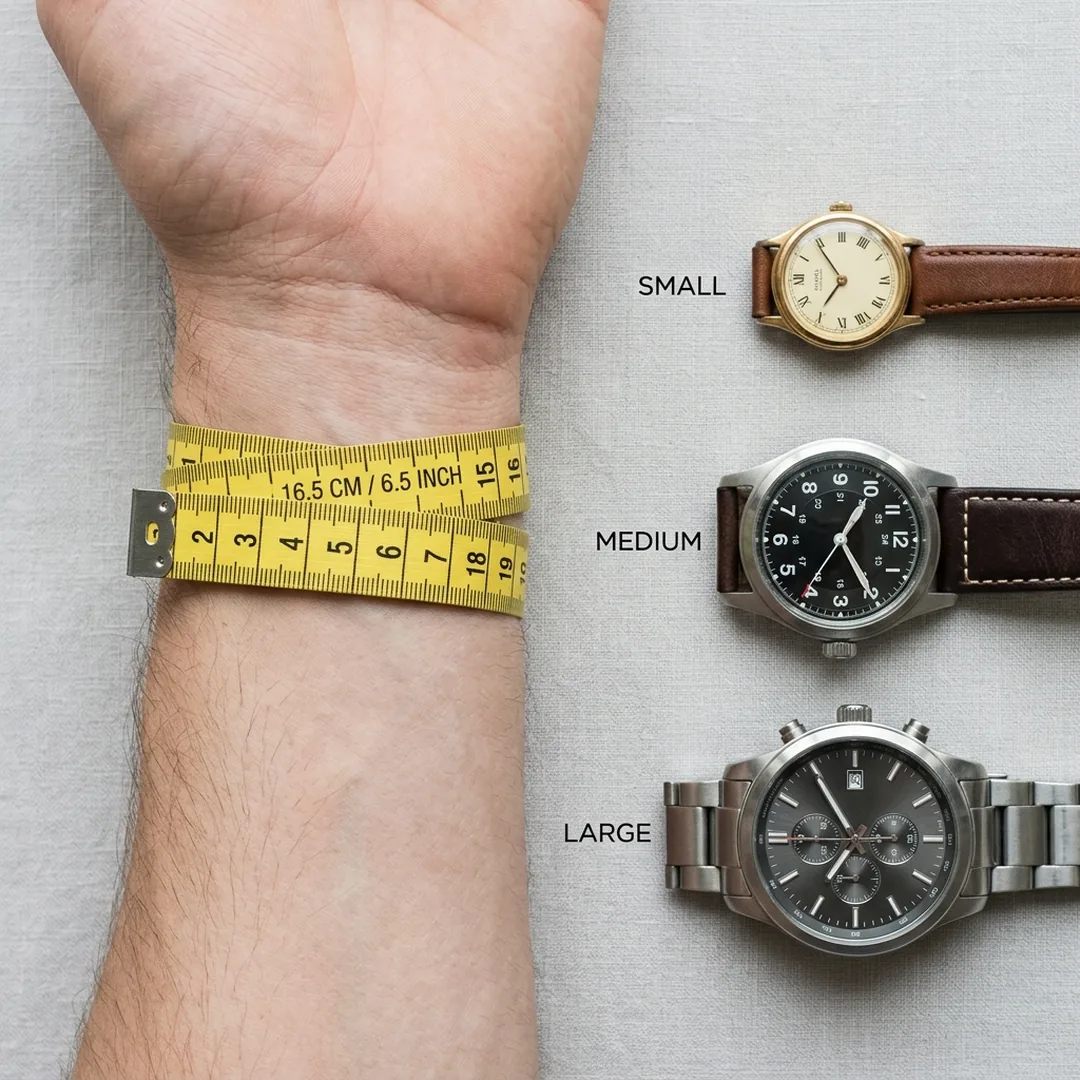
Direct Answer: Wrap a soft tape measure (or a strip of paper) snugly around your wrist bone, note the measurement in inches or centimeters, then use that number to find your ideal case diameter range.
How to Measure Your Wrist Accurately
- Use a flexible tape measure, or a strip of paper and a ruler if you don't have one.
- Wrap it around your wrist, right where a watch would normally sit — just past the wristbone.
- Keep it snug but not tight. You should be able to slide one finger underneath.
- Record the number in both inches and centimeters.
- Measure twice and average the result, since wrists can vary slightly between morning and evening due to water retention.
Average Wrist Size Reference Table
| Category | Average Wrist Circumference |
|---|---|
| Small (petite frame) | 5.5–6.0 inches (14–15.2 cm) |
| Medium (average adult) | 6.5–7.0 inches (16.5–17.8 cm) |
| Large (broad frame) | 7.5–8.0+ inches (19–20.3+ cm) |
Most adult wrists fall between 6 and 8 inches, with the average adult male wrist around 7 inches and the average adult female wrist around 6 inches — but this varies significantly by body type, so always measure your own rather than relying on averages.
Step 2: Match Wrist Size to Watch Case Diameter
Direct Answer: Case diameter is measured edge-to-edge across the widest point of the watch face, excluding the crown. Smaller wrists need smaller diameters to avoid overhang; larger wrists can support wider cases without the watch looking undersized.
Wrist-to-Case-Diameter Sizing Chart
| Wrist Circumference | Recommended Case Diameter | Typical Fit |
|---|---|---|
| Under 6 inches (15.2 cm) | 34–36mm | Petite / delicate |
| 6.0–6.5 inches (15.2–16.5 cm) | 36–38mm | Slim / classic |
| 6.5–7.0 inches (16.5–17.8 cm) | 38–40mm | Balanced / versatile |
| 7.0–7.5 inches (17.8–19 cm) | 40–42mm | Standard / sporty |
| 7.5–8.0 inches (19–20.3 cm) | 42–44mm | Bold / oversized |
| Over 8.0 inches (20.3+ cm) | 44–46mm+ | Statement / tool watch |
Expert tip: These ranges aren't rigid rules. A 40mm dress watch with thin bezels can look smaller than a 38mm sports watch with a thick bezel and raised crystal, because visual weight matters as much as raw diameter.
Step 3: Don't Ignore Lug-to-Lug Length
Direct Answer: Lug-to-lug (L2L) is the distance from the top lug tip to the bottom lug tip, measured in a straight line. It determines whether the watch physically overhangs your wrist — and it matters more than case diameter for comfort.
Two watches can share the same 40mm diameter but have wildly different lug-to-lug measurements — one might measure 47mm, another 52mm. On a 6.5-inch wrist, that five-millimeter difference is the gap between a watch that sits flush and one that visibly hangs off both edges.
How to Check Lug-to-Lug Fit
- Find the L2L spec on the product page or manual (most brands list it).
- As a rule of thumb, L2L should not exceed roughly 85–90% of your wrist's flat-top width (not the full circumference).
- If no spec is listed, hold the watch against your wrist before buying, or check unboxing/review videos that show it worn.
Common Mistake
Buying based on diameter alone. A 42mm diver's watch with short, curved lugs can fit a 6.5-inch wrist beautifully, while a 40mm pilot's watch with long, flat lugs might overhang the same wrist badly. Always check both numbers together.
Step 4: Consider Case Thickness
Direct Answer: Case thickness affects how a watch sits under a cuff and how it feels when your wrist bends. Thinner cases (under 10mm) suit dress and everyday wear; thicker cases (12mm+) suit dive, chronograph, and tool watches but can catch on sleeves for smaller-framed wearers.
| Case Thickness | Best For |
|---|---|
| Under 8mm | Ultra-thin dress watches, formal wear |
| 8–10mm | Everyday, office, versatile wear |
| 10–12mm | Sport watches, chronographs |
| 12mm+ | Dive watches, tool watches, bold statement pieces |
If you frequently wear long-sleeve dress shirts, a thinner case will slide under a cuff far more comfortably than a chunky dive watch.
Step 5: Match the Dial and Strap Width to Your Frame
Beyond the case, two more measurements shape the final fit:
- Dial width vs. bezel: A thick bezel makes a watch appear larger than its stated diameter. If you have a small wrist but want a bolder look, choose a design with a wide dial and thin bezel rather than sizing up the case itself.
- Strap or bracelet width: Wider straps (22mm+) visually balance larger wrists; narrow straps (16–18mm) suit smaller wrists and prevent the watch head from looking disproportionately small on a wide band.
Step 6: Try the "Overhang Test" Before Buying
Direct Answer: Rest the watch on your wrist without fastening it. If any part of the case extends past the edge of your wristbone on either side, the watch is too large for a proportionate fit.
Overhang Test — Step by Step
- Place the watch face-up on top of your wrist, positioned where you'd normally wear it.
- Look at both edges from directly above.
- A well-fitted watch sits entirely within the flat top of your wrist, without lugs curling over the sides.
- If the case or lugs hang off either edge, size down or choose a model with a shorter lug-to-lug.
This is the single most reliable real-world check, and it works even if you're shopping online and can only assess measurements from photos and spec sheets.
Watch Sizing by Wrist Type: Flat vs. Rounded
Not all wrists with the same circumference fit the same way, because wrist shape changes how a case sits.
- Flat wrists (wider, flatter top surface) can comfortably support larger cases and longer lug-to-lug measurements, since there's more flat real estate for the watch to rest on.
- Rounded wrists (narrower, more circular cross-section) tend to look better with curved case backs and shorter lug-to-lug lengths, since a large flat case can rock or tilt on a rounded surface.
If you're unsure which type you have, look at your wrist from the side: a flatter profile with visible top and side planes is a flat wrist; a smooth, even curve all the way around is a rounded wrist.
Men's vs. Women's Watch Sizing: What's Actually Different
The "men's" and "women's" labels on watches are really just diameter and styling conventions, not biological requirements — anyone can wear any size that fits their wrist comfortably.
| Category | Typical Diameter Range | Notes |
|---|---|---|
| "Women's" sizing | 26–34mm | Smaller cases, often thinner straps and dials |
| "Unisex" / midsize | 34–40mm | Increasingly the most popular category |
| "Men's" sizing | 38–46mm | Larger cases, thicker straps, bolder dials |
The unisex and midsize category has grown rapidly because it lets people size based on actual wrist measurement rather than gendered marketing.
Smartwatch Sizing: Is It Different?
Direct Answer: Smartwatch sizing follows the same wrist-to-case-diameter logic as traditional watches, but most smartwatch brands simplify it into two case sizes (small/medium and large) rather than a full range of diameters.
Example: Common Smartwatch Size Tiers
| Brand Example | Smaller Case | Larger Case |
|---|---|---|
| Apple Watch | 41mm | 45mm (plus Ultra at 49mm) |
| Samsung Galaxy Watch | 40–41mm | 44–46mm |
| Garmin fitness watches | 38–42mm | 45–51mm |
For smartwatches, wrists under 6.5 inches generally do better with the smaller case size, both for comfort and because smaller cases weigh less for all-day and overnight wear (important for sleep tracking).
Common Mistakes When Choosing Watch Size
- Sizing based on trends, not measurement. Oversized watches trend in and out of fashion, but a watch that overhangs your wrist will never feel comfortable regardless of the trend.
- Ignoring lug-to-lug length. Diameter alone doesn't determine fit — see Step 3 above.
- Not accounting for case thickness with cuffs and sleeves. A thick case can be uncomfortable under long sleeves even if the diameter is correct.
- Buying online without checking a wear photo or size comparison. Many retailers post photos of the watch on a ruler or a model's wrist — use these to cross-check your own measurement.
- Assuming gendered sizing applies to you. Choose based on wrist measurement, not the "men's" or "women's" label on the listing.
Watch Sizing Checklist
Use this checklist before finalizing any watch purchase:
- Measured wrist circumference with a tape measure or paper strip
- Matched circumference to the case diameter chart above
- Checked the lug-to-lug measurement against wrist width
- Considered case thickness for sleeve and cuff clearance
- Identified flat vs. rounded wrist shape
- Performed the overhang test (in-store or via photo comparison)
- Confirmed strap/bracelet width feels proportionate
Frequently Asked Questions (FAQ)
Q1: What size watch fits a 7-inch wrist?
A 7-inch wrist typically fits a case diameter between 38mm and 42mm comfortably, with a lug-to-lug length under roughly 47–50mm to avoid overhang.
Q2: Is a 42mm watch too big for a 6.5-inch wrist?
It depends on the lug-to-lug length and bezel thickness, but generally 42mm is on the larger end for a 6.5-inch wrist. A 38–40mm case with a short lug-to-lug measurement is usually a safer, more proportionate choice.
Q3: How do I know if a watch is too big for my wrist?
If the case or lugs extend past the edge of your wristbone when the watch is resting flat on your wrist (the overhang test), it's too large. A watch that rocks side to side when your wrist bends is also a sign it doesn't fit the wrist's curvature.
Q4: Do women have to wear smaller watches?
No. Watch size should be based on wrist circumference and personal style preference, not gender. Many people with smaller wrists choose 40mm+ cases intentionally for a bolder look, and many people with larger wrists prefer smaller, minimalist dials.
Q5: What's the average wrist size for adults?
The average adult wrist falls between 6 and 8 inches in circumference, with adult male wrists averaging around 7 inches and adult female wrists averaging around 6 inches, though individual variation is significant.
Q6: Should I size a watch bigger if I have a long forearm?
Not necessarily. Forearm length doesn't change wristbone width, which is what determines proportionate case size. Focus on wrist circumference and lug-to-lug length rather than forearm or arm length.
Q7: Can I resize a watch that's too big or too small?
The case diameter itself cannot be resized, but the strap or bracelet can usually be adjusted by a jeweler or watchmaker (removing bracelet links or trimming a leather strap) to fine-tune comfort once you've chosen the right case size.
Q8: What is lug-to-lug measurement and why does it matter more than diameter?
Lug-to-lug is the straight-line distance from the top of the case (where the strap attaches) to the bottom. It matters more than diameter because it directly determines whether the watch physically overhangs the wrist, which diameter alone doesn't tell you.
- Measure your wrist circumference first — it's the foundation of correct sizing.
- Match circumference to case diameter using the reference chart, but don't stop there.
- Lug-to-lug length is often more important than diameter for actual comfort and fit.
- Case thickness affects how the watch sits under sleeves and cuffs.
- Wrist shape (flat vs. rounded) influences which case backs and lug styles fit best.
- Gendered "men's" and "women's" sizing is a styling convention, not a rule — size to your actual wrist.
- Always perform the overhang test before finalizing a purchase, especially online.

Elina is a TrendRouge fashion and lifestyle writer focused on timeless style, beauty routines, accessories, and everyday elegance. Her guides combine practical styling advice with polished editorial insight for modern readers.