Most people assume "expensive-looking" means buying designer labels. It doesn't. Stylists and image consultants consistently point to fit, fabric, and finish as the three factors that separate a $20 outfit that looks $20 from a $20 outfit that looks $200. This guide breaks down exactly how to apply that principle to everyday casual wear, with practical steps, examples, and a shopping checklist you can use today.
Table of Contents
- Why Some Outfits Look Expensive and Others Don't
- The 8 Core Principles of Expensive-Looking Casual Style
- Step-by-Step: Building an Expensive-Looking Capsule Wardrobe on a Budget
- Fabric Guide: What to Buy and What to Avoid
- Color Theory for a Luxe Look
- Fit and Tailoring: The Single Biggest Upgrade
- Shoes, Bags, and Accessories That Punch Above Their Price
- Grooming and Presentation Details People Overlook
- Where to Shop Cheap Without Looking Cheap
- Common Mistakes That Make Budget Outfits Look Cheap
- A Sample "Expensive Casual" Outfit Formula
- Frequently Asked Questions (FAQ)
- Key Takeaways
Why Some Outfits Look Expensive and Others Don't
The human eye reads "expensive" through a handful of visual cues, long before it registers a logo. Research from fashion merchandising studies and the observations of professional stylists point to the same short list every time:
- Fit — how well the garment follows the body's actual shape
- Fabric structure — whether the material holds its shape or clings and wrinkles
- Color harmony — whether the outfit reads as one coordinated look or several unrelated pieces
- Proportion — whether hems, sleeves, and layers are balanced
- Finishing details — stitching, buttons, ironing, and shoe condition
- Confidence and posture — how the person wears the clothes
Notice that "price" isn't on the list. A $500 t-shirt that's baggy in the wrong places and wrinkled will look cheaper than a $12 t-shirt that's pressed and fits perfectly. This is genuinely good news for anyone shopping on a budget: the levers that matter most are also the ones that cost the least to control.
The Psychology Behind "Expensive Looking"
People associate expensive clothing with intentionality. Luxury brands sell simplicity, restraint, and precision — not flash. A person in a well-fitted plain white shirt and dark denim reads as more put-together than someone wearing three clashing prints, even if the prints cost more. This is why minimalist, "quiet luxury" style has become so popular: it's easier to execute affordably than heavily branded or trend-driven looks.
The 8 Core Principles of Expensive-Looking Casual Style
| # | Principle | Why It Works | Cost to Implement |
|---|---|---|---|
| 1 | Tailor everything | Fit is the #1 visual cue for quality | $10–$25 per item |
| 2 | Limit your palette | Coordinated colors look intentional | $0 |
| 3 | Choose structured fabric | Holds shape, resists wrinkling | Often the same price as flimsy fabric |
| 4 | Iron and steam | Removes the "cheap" wrinkle signal | Under $30 one-time |
| 5 | Invest in shoes | Shoes are the first thing people notice | Reallocate budget here |
| 6 | Remove excess logos/graphics | Logos read as loud, not luxe | $0 |
| 7 | Layer with purpose | Adds structure and visual interest | $0–$20 |
| 8 | Groom consistently | Skin, hair, and nails frame the outfit | Low cost, high impact |
Each of these is explored in depth below.
Step-by-Step: Building an Expensive-Looking Capsule Wardrobe on a Budget
Step 1: Audit what you already own. Lay out everything and separate pieces into "fits well," "needs tailoring," and "doesn't fit at all." Most people already own 60–70% of an expensive-looking wardrobe; it just needs adjusting.
Step 2: Pick a 3-color base palette. Choose one neutral (black, navy, white, beige, or grey), one secondary neutral, and one accent color. Every new purchase should work within this palette.
Step 3: Prioritize five foundation pieces.
- A well-fitted white or off-white shirt
- Dark, structured jeans or trousers
- A neutral crewneck or quarter-zip sweater
- A structured jacket (denim, bomber, or blazer)
- Clean, minimal sneakers or leather shoes
Step 4: Get everything tailored. Take new and existing pieces to a local tailor for hemming and slimming. This single step transforms budget clothing more than any other.
Step 5: Add two or three "detail" pieces. A leather (or leather-look) belt, a simple watch, or a structured bag adds polish without needing a large wardrobe.
Step 6: Maintain, don't just buy. Steam, iron, de-pill, and store clothes properly. Maintenance is what keeps a budget wardrobe looking expensive long-term.
Fabric Guide: What to Buy and What to Avoid
Fabric is the second-biggest factor after fit. Here's a simple comparison:
| Look For | Avoid |
|---|---|
| Cotton twill, denim, wool-blend | Thin, shiny polyester |
| Heavier-weight cotton t-shirts (180–220 GSM) | Sub-150 GSM "tissue thin" tees |
| Ponte knit or structured knit trousers | Stretchy, thin jersey trousers |
| Matte finishes | High-shine, plasticky finishes |
| Fabrics that hold a crease | Fabrics that wrinkle instantly and don't recover |
Expert tip: In-store, scrunch a piece of fabric in your hand for five seconds and let go. Fabric that instantly falls flat and holds its shape reads as higher quality than fabric that stays creased and rumpled — regardless of the price tag.
Color Theory for a Luxe Look
Limiting and coordinating color is one of the fastest, completely free ways to look more expensive.
- Monochrome dressing (same color family top to bottom) instantly elongates the body and looks curated.
- Neutral bases with one accent (e.g., all beige and white with a single navy accessory) reads as intentional styling.
- Avoid more than three colors in one outfit, especially loud, unrelated brights — this is one of the fastest ways to look "thrown together."
- Match undertones, not just colors. A warm-white shirt with a cool-white sneaker can look mismatched even though both are "white."
Fit and Tailoring: The Single Biggest Upgrade
If you take away one thing from this guide, make it this: fit outperforms price every time.
Fit Checklist by Garment
- Shoulders: Seam should sit exactly at the shoulder bone, not drooping past it.
- Sleeves: Should end at the wrist bone for shirts, slightly above for jackets.
- Waist: Trousers should sit at the natural waist or hip without gaping or pulling.
- Hem length: Jeans should have a slight break or a clean crop; avoid excess pooling fabric at the ankle.
- Shirt length: Should be long enough to stay tucked but not so long it bunches.
Cheap Tailoring Wins
A local tailor can hem pants, slim a waist, taper sleeves, or take in a boxy shirt for a small fee — often $10 to $25 per alteration. This is consistently the highest return-on-investment move in budget styling because it applies to every piece you own, not just new purchases.
Shoes, Bags, and Accessories That Punch Above Their Price
Stylists often say: "People notice your shoes before they notice your shirt." Feet and hands (shoes and bags) are inspected more closely than fabric from a distance.
- Shoes: Clean, minimal leather or leather-look shoes in white, black, or brown look far more expensive than heavily branded, brightly colored sneakers. Keep them clean — scuffed or yellowed soles undercut an entire outfit.
- Bags: A structured, plain bag in a neutral tone looks more premium than a logo-covered bag in a synthetic material.
- Belts: Match belt color to shoe color for a coordinated look.
- Watches: A simple analog watch adds polish instantly and is one of the cheapest ways to elevate a casual outfit.
- Jewelry: Fewer, slightly heavier-looking pieces (in gold or silver tone, matched consistently) look more intentional than many small mixed-metal pieces.
Grooming and Presentation Details People Overlook
Clothes are only part of the picture. These free or low-cost habits change how "expensive" the whole look reads:
- Ironed or steamed clothing (a $25–$40 handheld steamer pays for itself immediately)
- Clean, trimmed nails
- Well-maintained hair, even if simply washed and brushed
- Fresh-smelling clothes (musty or heavily fragranced clothing reads as "cheap" regardless of the garment)
- Good posture — standing tall changes how fabric falls on the body
Where to Shop Cheap Without Looking Cheap
- Thrift and consignment stores often carry higher-quality fabrics from past seasons at a fraction of retail price.
- Basics-focused retailers (store brands built around plain staples) tend to have better fabric-to-price ratios than fast-fashion, trend-driven retailers.
- End-of-season sales at mid-range retailers frequently beat "luxury" fast fashion on both quality and price.
- Sample sales and outlet stores can offer better-constructed garments at close to fast-fashion prices.
Expert tip: When shopping secondhand, prioritize outerwear, denim, and shoes — these categories show wear the least and offer the best quality-per-dollar.
Common Mistakes That Make Budget Outfits Look Cheap
- Wearing wrinkled or unpressed clothing
- Mixing more than three unrelated colors
- Oversized graphic logos and text-heavy prints
- Ill-fitting shoulders, sleeves, or hems
- Visible pilling, fading, or stretched-out necklines
- Mismatched metal tones in jewelry
- Overly shiny, synthetic fabrics
- Neglecting shoe condition
A Sample "Expensive Casual" Outfit Formula
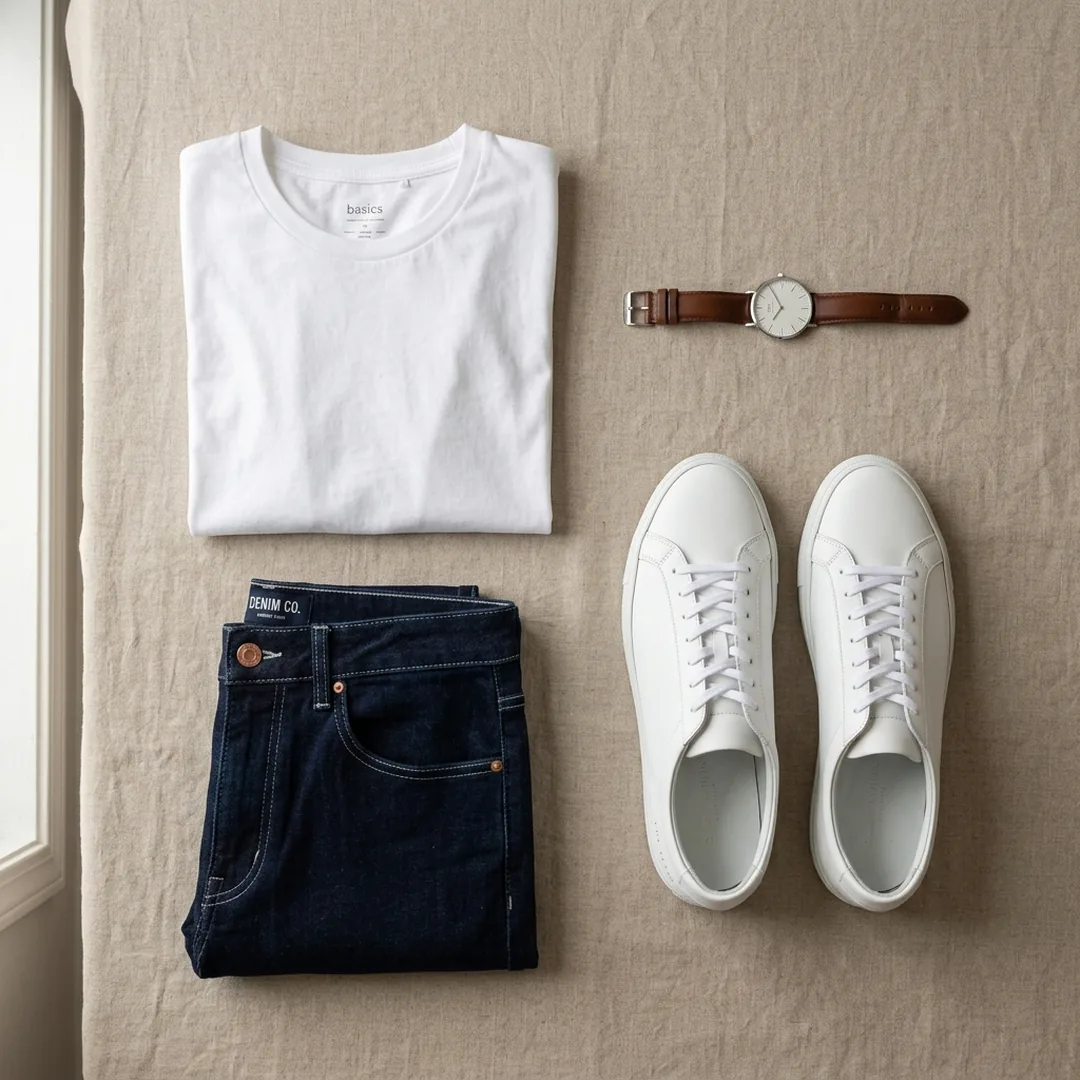
The Weekend Elevated Look
- Well-fitted plain white t-shirt (heavier cotton, tucked or half-tucked)
- Dark, straight-leg jeans, tailored to a clean break at the ankle
- Minimal white leather sneakers, clean
- Structured bomber or denim jacket in a neutral tone
- Simple leather watch and matching belt
The Smart-Casual Look
- Quarter-zip sweater in a neutral tone
- Tailored chinos
- Clean brown leather loafers or minimal sneakers
- Structured crossbody or tote bag in a matching neutral
Both formulas rely on the same principles: fitted silhouette, matched palette, structured fabric, and clean finishing details.
Frequently Asked Questions (FAQ)
Q1: What is the cheapest way to make an outfit look more expensive?
Tailoring is the cheapest high-impact change. Taking in a shirt or hemming pants at a local tailor for $10–$25 improves the look of an outfit more than almost any purchase.
Q2: Does ironing really make that much of a difference?
Yes. Wrinkled clothing is one of the strongest visual signals of "cheap," while pressed or steamed clothing signals care and quality, regardless of the garment's actual price.
Q3: Can thrifted clothes look expensive?
Absolutely. Thrifted and secondhand clothing often has better fabric quality than current fast fashion, especially in denim, coats, and knitwear, and tailoring makes it fit as if it were made for you.
Q4: How many colors should be in one casual outfit?
Stick to two or three coordinated colors. A tight, intentional palette reads as far more polished than an outfit with four or more unrelated colors.
Q5: Do logos make an outfit look cheaper?
Large, visible logos and graphic branding often read as trying too hard. Minimal or logo-free pieces tend to look more premium and versatile.
Q6: What's the single best budget item to invest slightly more in?
Shoes. Clean, well-maintained, simple shoes are one of the first things people notice and one of the fastest ways to elevate or undercut an entire outfit.
Q7: How do I know if a piece of clothing fits well?
Shoulders should align with the shoulder seam, sleeves should hit the wrist bone, waistbands shouldn't gap or pull, and hems shouldn't pool or ride up.
Q8: Is it better to buy fewer, better pieces or more cheap pieces?
Fewer, well-fitted, well-coordinated pieces almost always look more expensive than a large wardrobe of mismatched, ill-fitting items.
- Fit matters more than price — tailoring is the highest-impact, lowest-cost upgrade available.
- Structured, matte fabrics look more expensive than shiny, thin synthetics, often at the same price point.
- A limited, coordinated color palette (2–3 colors) instantly looks more intentional.
- Shoes and grooming details are inspected closely and should be prioritized in a limited budget.
- Ironing, steaming, and general garment maintenance are free or low-cost ways to look polished.
- Thrifted and secondhand clothing, tailored to fit, can outperform new fast fashion in both quality and appearance.

Elina is a TrendRouge fashion and lifestyle writer focused on timeless style, beauty routines, accessories, and everyday elegance. Her guides combine practical styling advice with polished editorial insight for modern readers.