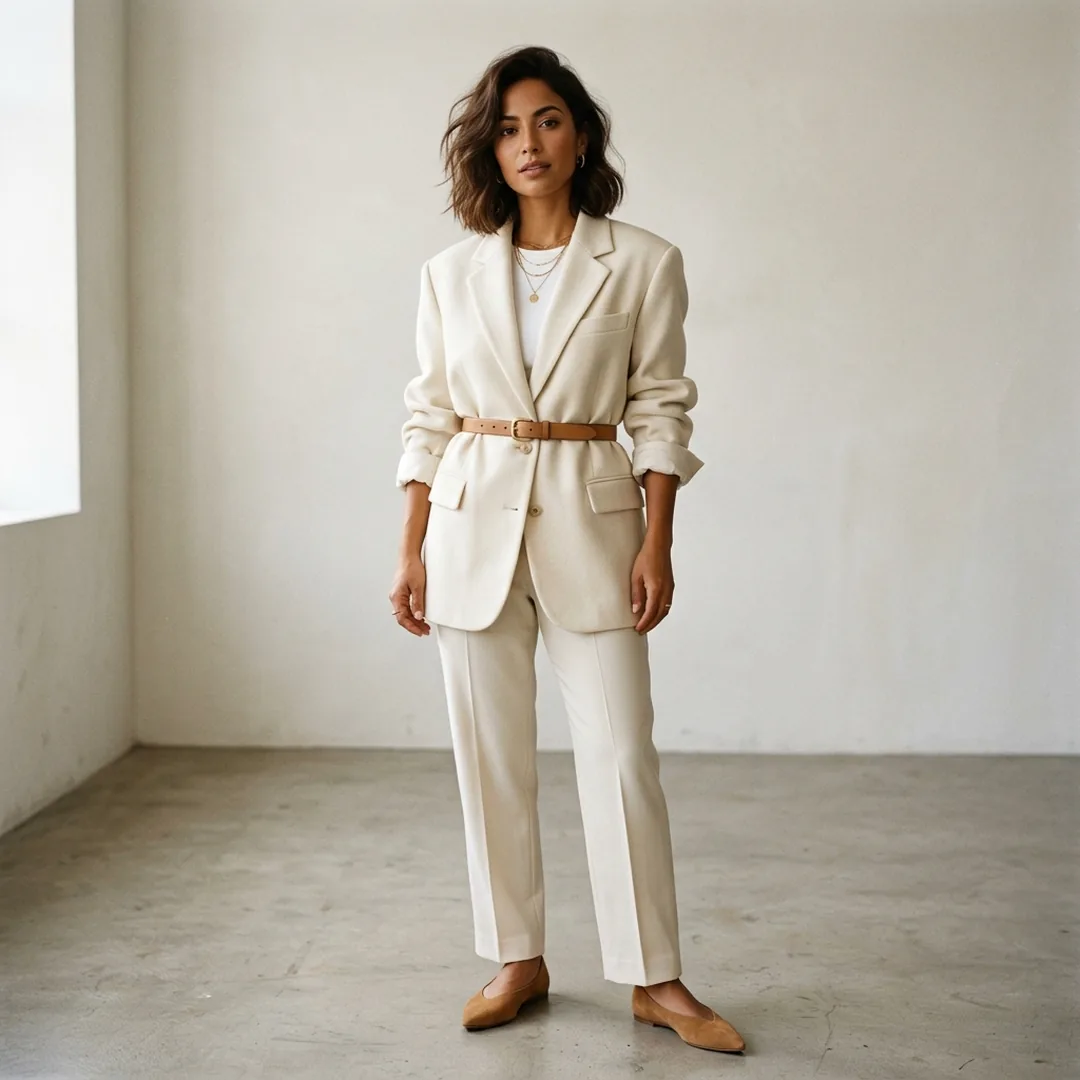
If you're 5'4" or under and have ever bought an oversized blazer only to feel like you're wearing a costume, this guide will fix that. Below is everything you need: the exact proportion rules, styling formulas, mistakes to avoid, and outfit ideas broken down by body type, season, and occasion.
Table of Contents
- Why Oversized Blazers Are Tricky for Petite Frames
- The 5 Proportion Rules That Actually Work
- How to Choose the Right Oversized Blazer (Buying Guide)
- Step-by-Step Styling Formula
- Outfit Ideas by Occasion
- Styling by Body Shape
- Seasonal Styling Tips
- Common Mistakes Petite Women Make
- Expert Tailoring Tips
- FAQs
Why Oversized Blazers Are Tricky for Petite Frames
Oversized blazers are having a permanent moment — they show up in office wear, street style, and evening looks. But most oversized blazers are drafted on standard or tall sample sizes. On a petite frame (generally 5'4" and under, with a proportionally shorter torso and arm length), an unaltered oversized blazer can:
- Drop the shoulder seam too far down the arm, shortening your visible arm length
- Extend the hem past the widest part of the hip or even to the knee, cutting your leg line in half
- Swallow the waistline, erasing any definition
- Make sleeves bunch at the wrist instead of at the forearm
None of this means petite women should avoid the trend. It means the styling has to do more work than it does on a taller frame. The fix is proportion management, not avoidance.
The 5 Proportion Rules That Actually Work
-
Shoulder Seam Rule
Direct answer: The shoulder seam of the blazer should sit at or very close to your natural shoulder point — not more than half an inch past it.
Oversized doesn't have to mean dropped shoulder. A blazer can be roomy through the body and sleeve while the shoulder seam stays put. This single detail does more for a petite silhouette than almost anything else, because a dropped shoulder visually shortens your arm and widens your upper body in a way that reads as "borrowed clothing" rather than "styled."
-
Sleeve-to-Wrist Rule
Direct answer: Roll or push up the sleeves so at least one to two inches of wrist are visible.
Exposed wrist is one of the fastest ways to make oversized tailoring look deliberate instead of accidental. It breaks up the mass of fabric and adds a defined edge to the silhouette.
-
The One-Third Torso Rule
Direct answer: The blazer should cover no more than roughly two-thirds of your torso length when worn open, so your legs still read as the longer portion of your outline.
Petite women have proportionally shorter torsos relative to leg length in most cases, but an oversized blazer that hits mid-thigh or lower flips that ratio and visually shortens the leg line. Aim for a hem that lands between the top of the hip bone and mid-hip when possible.
-
Waist Definition Rule
Direct answer: Create a visible waistline somewhere in the outfit — through a belt, a tucked-in layer underneath, or by wearing the blazer open over a fitted top.
Because volume without a waist reference reads as "bigger," not "oversized-chic." A defined waist gives the eye an anchor point.
-
Bottom-Half Balance Rule
Direct answer: Pair volume on top with a slim or tailored silhouette on the bottom — skinny trousers, straight-leg jeans, a fitted skirt, or leggings.
Oversized on oversized (baggy blazer with wide-leg trousers) is a proportion that works on taller frames with more vertical room to play with. On a petite frame it usually needs one fitted counterpoint to avoid looking shapeless.
How to Choose the Right Oversized Blazer (Buying Guide)
| Feature | What to Look For | What to Avoid |
|---|---|---|
| Shoulder seam | Sits at or near natural shoulder | Drops 1+ inch past shoulder |
| Sleeve length | Long enough to roll/cuff | So long it bunches with no clean fold |
| Hem length | Hip to high-thigh | Past mid-thigh or knee-length |
| Shoulder pads | Light structure, not exaggerated | Heavy padding that widens the frame |
| Fabric weight | Mid-weight structured fabric (holds shape) | Very stiff, heavy fabric that stands away from the body |
| Lapel size | Medium lapel, proportional to frame | Oversized lapel that competes with a small frame |
| Button placement | Set slightly higher, not at natural waist-low | Very low button stance that lengthens torso too much |
Expert tip: When trying on an oversized blazer, do the "arm test" — raise your arms as if reaching for something on a shelf. If the shoulder seam pulls dramatically or the sleeve rides up past your elbow, the fit is too big even for the oversized trend.
Step-by-Step Styling Formula
Direct answer: Fitted or cropped bottom + tucked or fitted top + rolled sleeves + defined waist + heeled or platform shoe = a balanced oversized-blazer outfit for petite frames.
- Start with the bottom half. Choose slim trousers, straight-leg denim, a pencil skirt, or fitted leggings. This is your proportion anchor.
- Layer a fitted or tucked-in top underneath. A fitted tank, turtleneck, or button-down tucked into the waistband creates the waist reference the blazer needs.
- Put the blazer on and check the hem. If it falls past mid-thigh, consider belting it or having it tailored (see the tailoring section below).
- Roll the sleeves. Fold once or twice until one to two inches of wrist show.
- Add a waist definition element if the blazer will be worn buttoned. A slim belt over the blazer, cinched at the natural waist, instantly corrects the silhouette.
- Choose footwear that lengthens the leg line. Pointed-toe flats, heeled boots, or a low block heel all help counterbalance the volume up top.
- Keep accessories minimal and vertical. Long necklaces, a single structured bag, or drop earrings draw the eye up and down rather than across, which reinforces height.
Outfit Ideas by Occasion
Office / Workwear
- Cream oversized blazer, buttoned, sleeves rolled, over a fitted black tank, straight-leg trousers, pointed flats.
- Checked oversized blazer worn open over a fitted turtleneck, slim midi skirt, ankle boots.
Casual / Weekend
- Oversized denim-toned blazer over a white tee, tucked, with straight-leg jeans and white sneakers.
- Neutral oversized blazer belted at the waist over leggings and an oversized-but-cropped hoodie underneath, with chunky sneakers.
Evening / Date Night
- Black oversized blazer worn as a dress — belted at the waist, worn over a fitted slip dress or bike shorts, with heeled sandals.
- Satin oversized blazer, sleeves rolled, over a fitted camisole and slim trousers, with heels.
Smart Casual
- Camel oversized blazer over a fitted rib-knit top, straight jeans, loafers, and a structured crossbody bag.
Styling by Body Shape
| Body Shape | Styling Focus | Best Blazer Choice |
|---|---|---|
| Petite + Hourglass | Emphasize the waist with a belt or tucked layer | Slightly structured blazer, buttoned or belted |
| Petite + Rectangle | Create waist illusion with a belt at the narrowest point | Oversized blazer with a slightly nipped-in back seam |
| Petite + Pear | Balance proportions by keeping the blazer shorter, drawing attention upward | Cropped-oversized hybrid or blazer worn open |
| Petite + Apple | Wear open over a fitted top to create a long vertical line | Longline oversized blazer worn unbuttoned |
| Petite + Inverted Triangle | Avoid extra shoulder volume; keep shoulder seam close to natural shoulder | Softer shoulder, no heavy shoulder pads |
Seasonal Styling Tips
Spring/Summer: Choose lightweight linen-blend oversized blazers, worn open over a fitted camisole, with cropped straight-leg trousers or a midi skirt.
Fall/Winter: Layer a fine-knit turtleneck underneath, add a slim belt for warmth-plus-shape, and pair with knee-high boots to keep the leg line long under a slightly longer hem.
Common Mistakes Petite Women Make
- Buying based on trend photos alone, without checking shoulder seam placement on their own frame.
- Pairing an oversized blazer with equally oversized bottoms, erasing all shape.
- Leaving sleeves unrolled, which hides the wrist and shortens the arm line.
- Choosing a hem that hits below mid-thigh, cutting the leg length visually in half.
- Skipping a waist reference entirely, so the outfit reads as "wearing something too big" instead of intentional oversized styling.
- Over-accessorizing horizontally (wide belts stacked with big scarves) instead of drawing the eye vertically.
Expert Tailoring Tips
A petite-specific tailor adjustment can transform an off-the-rack oversized blazer without losing the relaxed look:
- Shorten the sleeve length while keeping the shoulder as-is, so the sleeve ends at the styled roll point instead of past the hand.
- Take in the side seams slightly below the armhole to reintroduce a subtle waist without changing the shoulder or chest volume.
- Shorten the overall hem by one to three inches if it currently falls past mid-thigh.
- Move the button stance up slightly so the lapel break sits higher on the torso, which visually shortens the space between shoulder and waist in a flattering way.
These are low-cost adjustments (most tailors charge for hem and sleeve shortening) and are worth doing on any blazer you plan to wear more than a few times.
Frequently Asked Questions (FAQ)
Q1: Can petite women wear oversized blazers, or should they stick to fitted ones?
Yes, petite women can wear oversized blazers. The trend works on any height when the proportions are managed — specifically the shoulder seam placement, sleeve length, and hem length relative to torso length.
Q2: What length should an oversized blazer be for a petite woman?
Aim for a hem that falls between the top of the hip and mid-hip. Avoid hems that extend past mid-thigh, since that visually shortens the leg line on a shorter frame.
Q3: How do you keep an oversized blazer from looking too big on a small frame?
Roll the sleeves to show wrist, add a belt or tucked-in fitted top for waist definition, and pair the blazer with slim-fitting bottoms. These three adjustments do most of the work.
Q4: Should the shoulder seam of an oversized blazer be dropped for petite women?
No. Keep the shoulder seam at or very close to your natural shoulder point. A dropped shoulder shortens the visible arm and widens the frame, which works against a petite silhouette.
Q5: Can you wear an oversized blazer as a dress?
Yes — belt it at the natural waist and wear it over bike shorts or a fitted slip. This works best with blazers that fall at or above mid-thigh; anything longer can look unintentional rather than styled.
Q6: What shoes work best with an oversized blazer for a petite woman?
Pointed-toe flats, heeled boots, or a low block heel all elongate the leg line, which balances the volume of the blazer up top. Avoid chunky, ankle-strap styles that visually cut the leg.
Q7: Is it better to buy an oversized blazer in a petite size or a regular size?
If your brand offers a petite line, start there — it usually keeps the "oversized" silhouette while adjusting sleeve and torso length. If not, buy in your regular size and plan for minor tailoring (sleeve and hem shortening) rather than sizing down, which would remove the oversized effect entirely.
Q8: Can oversized blazers be worn for work by petite women?
Yes. Keep it polished by buttoning the blazer, choosing a neutral color, rolling sleeves neatly, and pairing with tailored trousers or a pencil skirt and structured shoes.
- Keep the shoulder seam close to your natural shoulder — don't go for a heavily dropped shoulder.
- Roll sleeves to show wrist; it instantly makes the fit look intentional.
- Hem should land between hip and mid-hip, not past mid-thigh.
- Always create a waist reference — belt, tuck, or wear open over a fitted top.
- Pair blazer volume with slim, fitted bottoms for balance.
- Minor tailoring (sleeve and hem shortening) makes a huge difference on off-the-rack pieces.

Elina is a TrendRouge fashion and lifestyle writer focused on timeless style, beauty routines, accessories, and everyday elegance. Her guides combine practical styling advice with polished editorial insight for modern readers.