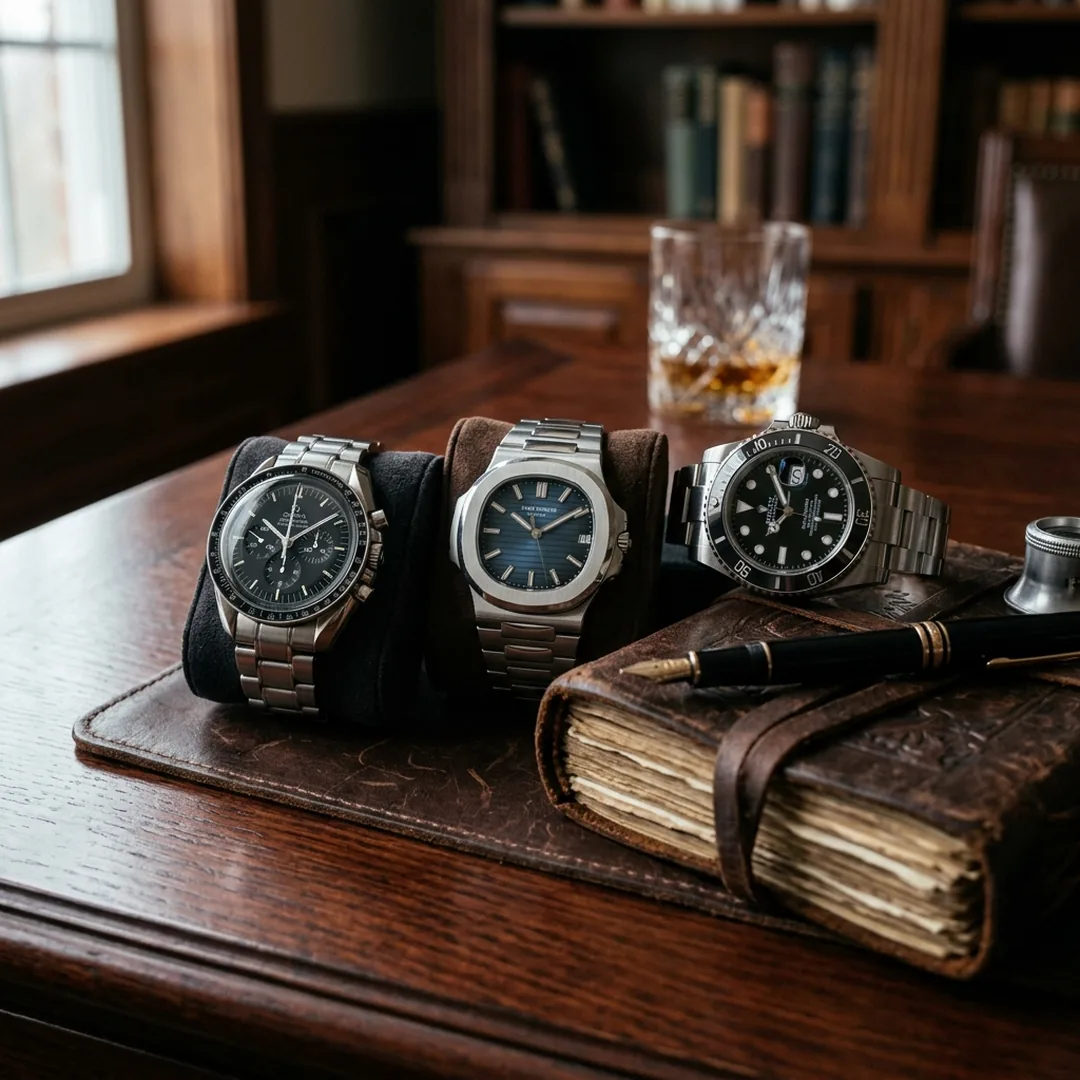
There's something deeply personal about a great watch. It sits on your wrist, moves with you, and tells the world something about who you are — without saying a single word. That's why luxury watches every man should know aren't just about telling time. They're about heritage, craftsmanship, and making a statement that lasts generations.
Whether you're buying your first serious timepiece, building a collector's wardrobe, or simply curious about what separates a $500 watch from a $50,000 one — this guide covers every angle. From the legendary Swiss maisons to the movements behind the magic, here's what every man needs to know before stepping into the world of fine horology.
Table of Contents
- Why Luxury Watches Still Matter in 2026
- Understanding Watch Movements: The Heart of Every Timepiece
- The Luxury Watches Every Man Should Know
- How to Choose Your First Luxury Watch
- Luxury Watch Investment: What Holds Its Value?
- Caring for Your Luxury Watch
- FAQ: Luxury Watches Every Man Should Know
- Key Takeaways
Why Luxury Watches Still Matter in 2026
In an era where your smartphone tells the time with atomic precision, why does anyone spend tens of thousands of dollars on a mechanical watch?
The answer is simple: a luxury watch isn't a clock. It's a craft object. It's a conversation piece. It's often an investment that holds — or grows — in value over time. And for many men, it's one of the few pieces of jewelry that carries no social hesitation.
The global luxury watch market continues to thrive, driven by a renewed appreciation for craftsmanship and tangible, heirloom-quality objects in a disposable world. In 2026, demand for top-tier Swiss timepieces remains as strong as ever, with brands like Rolex, Patek Philippe, and Audemars Piguet on waiting lists that stretch for years.
Beyond status, a fine watch rewards its wearer with something money can't fully buy: mastery. The tiny gears, springs, and levers inside a mechanical movement — some smaller than a grain of rice — represent the pinnacle of human engineering. That's worth knowing about.
Understanding Watch Movements: The Heart of Every Timepiece
Before diving into the brands and models, every man should understand what makes a watch tick — literally.
Mechanical (Manual-Wind) Movements
A manual-wind watch requires you to wind the crown regularly to keep it running. It's the oldest, most traditional form of watchmaking. Brands like A. Lange & Söhne and Patek Philippe produce some of the most revered manual-wind calibers in existence. There's a certain intimacy in winding your watch each morning — a ritual that connects you to the craft.
Automatic (Self-Winding) Movements
Automatic movements use a rotor — a weighted half-disc that spins with the movement of your wrist — to wind the mainspring. Wear it regularly and it never stops. This is the most common movement type in luxury watches, used by Rolex, Omega, and Audemars Piguet. It offers mechanical romance without the daily obligation.
Quartz Movements
Quartz watches use a battery and a vibrating quartz crystal to keep time with remarkable accuracy. While less prestigious in collector circles, some quartz watches — like the Grand Seiko Quartz or certain Rolex Oysterquartz models — are historically significant and highly collectible.
In-House vs. Third-Party Movements
An in-house movement means the brand designed and manufactured its own caliber. This is a major mark of prestige. Rolex, Patek Philippe, and Audemars Piguet all use in-house movements. Some brands use movements from suppliers like ETA or Sellita, which isn't inherently inferior — but it does affect how collectors perceive value.
The Luxury Watches Every Man Should Know
1. Rolex Submariner — The Benchmark Diver
If there is one watch that defines luxury in the public imagination, it's the Rolex Submariner. Introduced in 1953, it was the world's first diver's watch water-resistant to 100 meters (today's models go to 300m). Its clean, functional design — rotating bezel, luminous dial, Mercedes hands — has barely changed in 70 years, because it doesn't need to.
The Submariner is the watch every other dive watch is measured against. It's worn by everyone from deep-sea divers to presidents to some of the world's most celebrated fictional spies. In steel, it retails around $10,500 — though good luck finding one at that price. Pre-owned examples often command significant premiums.
Why you should know it: It's the entry point for the entire conversation. If someone tells you they're into luxury watches, the Submariner is almost certainly in the picture.
2. Rolex Daytona — The Racer's Chronograph
Named after the famous Daytona International Speedway, the Rolex Cosmograph Daytona is the brand's legendary chronograph. Originally designed for professional racing drivers, it features a tachymeter bezel and three sub-dials for measuring elapsed time and speed.
The Daytona earned its mythological status partly through a famous story: Paul Newman wore one in the 1969 film Winning, and when his personal Daytona sold at auction in 2017, it fetched $17.75 million — a world record for any wristwatch at the time. That particular reference is now known simply as the "Paul Newman Daytona."
Current steel Daytonas retail at around $16,550, but waitlists stretch years and grey market prices run double or triple. In gold or platinum, prices escalate dramatically.
Why you should know it: It's arguably the most coveted wristwatch in the world. Understanding the Daytona means understanding watch collecting.
3. Rolex GMT-Master II — The Traveler's Classic
Developed in the 1950s in partnership with Pan American World Airways for their long-haul pilots, the GMT-Master II tracks two time zones simultaneously via a 24-hour bezel and a dedicated GMT hand. It's become one of the most recognizable tool watches ever made.
The colorful bezels — Pepsi (red/blue), Batman (black/blue), Root Beer (brown/gold) — have become almost as iconic as the watches themselves. Each nickname reflects the bezel color and the community that formed around it.
Why you should know it: It teaches a key lesson of horology: function drives design. The best luxury watches are never decorative alone.
4. Patek Philippe Nautilus — The Luxury Sports Icon
If Rolex is the people's champion of luxury watches, Patek Philippe is the connoisseur's choice. The Maison has been making watches in Geneva since 1839, and it holds a cherished position at the very summit of watchmaking.
The Nautilus, designed by the legendary Gérald Genta and launched in 1976, was a radical idea: a luxury sports watch in stainless steel, at a time when steel was considered a lesser material. Its distinctive porthole-inspired case and horizontally embossed dial changed the industry. Today, reference 5711 — the "entry-level" Nautilus in steel — has a retail price of around $35,000 and sells on the secondary market for many multiples of that.
Patek Philippe famously markets itself with the phrase: "You never actually own a Patek Philippe. You merely look after it for the next generation." That sentiment captures everything about what luxury watches mean at the highest level.
Why you should know it: The Nautilus is the watch that proves steel can be more desirable than gold. It's a lesson in how perception, design, and scarcity create value.
5. Audemars Piguet Royal Oak — The Original Luxury Sports Watch
The same designer who created the Nautilus — Gérald Genta — sketched the Royal Oak on a cocktail napkin in 1972 and changed watchmaking forever. Launched at a price higher than a gold Rolex despite being made in steel, the Royal Oak was an audacious statement.
Its octagonal bezel with exposed screws, integrated bracelet, and "tapisserie" guilloché dial became instantly iconic. The Royal Oak is what spawned the entire genre of high-end sports watches — the Nautilus, the IWC Ingenieur, the Vacheron Constantin Overseas — all owe their existence to AP's steel masterpiece.
In 2026, Audemars Piguet celebrated its 150th anniversary with special editions of the Royal Oak, including the extraordinary RD#5 — a 39mm ultra-thin piece that represents the ultimate expression of this iconic design.
Why you should know it: You cannot understand modern watchmaking without understanding the Royal Oak. It's the Big Bang of the luxury sports watch universe.
6. Omega Speedmaster — Moonwatch
On July 20, 1969, Neil Armstrong and Buzz Aldrin walked on the moon wearing Omega Speedmaster Professional watches on their wrists. That's not marketing. That's history. NASA's rigorous testing of multiple watch brands found only the Speedmaster capable of surviving the extreme conditions of space travel.
The Speedmaster has been on every crewed NASA mission since 1965 and remains in production today in an essentially unchanged form. It's one of the most historically significant objects a man can wear.
Beyond history, the Speedmaster is an exceptional chronograph with a column wheel mechanism and a manual-wind movement (Caliber 321 in heritage editions) that collectors obsess over.
Why you should know it: It went to the moon. That alone earns its place in this list — and on your wrist.
7. Omega Seamaster — Bond's Choice
While the Speedmaster has space, the Seamaster has cinema. James Bond has worn the Omega Seamaster since 1995's GoldenEye, making it one of the most famous watches in popular culture. More than just a movie prop, the Seamaster Diver 300M is a genuinely excellent dive watch featuring Omega's Co-Axial escapement, a ceramic bezel, and Master Chronometer certification — meaning it's accurate, reliable, and highly resistant to magnetic fields.
At $5,000 to $6,000, it represents one of the best entry points into Swiss luxury watchmaking.
Why you should know it: It's where millions of men begin their love affair with fine watches. Accessible, capable, and undeniably cool.
8. IWC Portugieser — Dress Watch Perfection
Founded in Schaffhausen, Switzerland, by an American entrepreneur in 1868, IWC Schaffhausen is one of the most technically accomplished watch brands in the world. The Portugieser (Portuguese in English) is their crown jewel for dress watch lovers.
Originally created in 1939 for Portuguese clients who wanted a pocket watch movement in a wristwatch case, the Portugieser is defined by its clean, oversized dial, Roman numerals, and blued-steel hands. In its Perpetual Calendar or Tourbillon variants, it reaches the pinnacle of horological complexity.
Why you should know it: Not every situation calls for a sporty diver. The Portugieser teaches men that restraint can be the most powerful statement of all.
9. Jaeger-LeCoultre Reverso — Art Deco Masterpiece
Invented in 1931 specifically for polo players who needed to protect their watch glass during matches, the Reverso features a case that literally flips over to reveal a protective steel caseback. What started as a practical solution became one of the most elegant watch designs in history.
The Reverso's rectangular Art Deco case is a canvas for incredible craftsmanship — enamel paintings, engravings, and intricate guillochage decorate the hidden back, making it among the most personal of luxury watches. Jaeger-LeCoultre, known as the "watchmaker's watchmaker," manufactures over 180 calibers in-house and supplies movements to some of the most prestigious brands in the world.
Why you should know it: It proves that necessity is the mother of invention — and that the greatest watches are often born from unexpected problems.
10. A. Lange & Söhne Lange 1 — German Precision
Most luxury watchmaking conversation gravitates toward Switzerland, but Germany has a powerful, often underappreciated tradition. A. Lange & Söhne, based in Glashütte, produces some of the most technically rigorous and visually distinctive watches in the world.
The Lange 1, introduced in 1994 after German reunification allowed the historic firm to reopen, features an off-centered dial layout, a large date display, and an outsize balance wheel visible through the caseback. Every Lange watch is assembled twice — once to test it, then disassembled, cleaned, and reassembled for delivery. The result is a watch of breathtaking quality.
Why you should know it: Lange represents the road not taken — a Germanic alternative to Swiss dominance that rewards those curious enough to look beyond Zurich and Geneva.
11. Grand Seiko — Japan's Finest Hour
For decades, Swiss watch enthusiasts dismissed Japanese watchmaking as inferior. Grand Seiko, Seiko's ultra-premium division, has spent decades proving that wrong. Their dials — inspired by the textures of Japanese nature, including snowflake patterns, birch forests, and mountain ranges — are considered among the most beautiful in all of horology.
Grand Seiko also developed the Spring Drive movement: a unique hybrid that combines mechanical energy storage with an electromagnetic brake controlled by a quartz oscillator. The result is sweep accuracy within one second per day, with a perfectly smooth seconds hand that almost seems to levitate.
Why you should know it: Grand Seiko challenges every assumption about what a luxury watch has to be. It's the essential counterargument to European supremacy in fine watchmaking.
12. Richard Mille — The Hypercar of Watches
If the watches above are sports cars, Richard Mille is a Formula One hypercar. Founded in 2001, Richard Mille created watches using materials borrowed from aerospace and motorsport engineering — carbon nanotubes, titanium-lithium alloy, NTPT carbon. Prices begin around $80,000 and regularly reach seven figures.
The brand is beloved by athletes, celebrities, and ultra-high-net-worth collectors who want a watch that performs under extreme physical stress. Rafael Nadal played the French Open wearing a Richard Mille RM 27-04 worth $800,000. Bubba Watson drove a golf ball while wearing a prototype. The watches are built to survive it.
Why you should know it: Even if you never own one, Richard Mille represents the outer edge of what a wristwatch can be — a statement that watches are still evolving.
How to Choose Your First Luxury Watch
So you're ready to make a move. Where do you start?
Define your budget honestly. The luxury watch market begins meaningfully around $3,000 to $5,000 (Longines, Hamilton, TAG Heuer, entry Omega). The $5,000–$15,000 range opens up Omega, Tudor, and pre-owned Rolex. Above $15,000, you're in Rolex retail and pre-owned Patek territory.
Decide on a movement type. If you want a connection to watchmaking tradition, choose mechanical. If accuracy and low maintenance matter more, consider a high-end quartz from Grand Seiko.
Consider your lifestyle. A Submariner works in a boardroom and on a dive boat. A Reverso is for dinners and gallery openings. Your first watch should suit where you actually live, not just where you aspire to be.
Buy from authorized dealers or reputable pre-owned sellers. The grey market is full of opportunity, but also risk. Brands like Bob's Watches, Chrono24, and WatchBox have established trustworthy pre-owned channels.
Buy what you love, not what you think you should love. The best luxury watch is the one you reach for every morning.
Luxury Watch Investment: What Holds Its Value?
Watches are not stocks. Most luxury watches will depreciate the moment you walk out of the boutique — just like a car. However, a select group of watches have historically held or grown in value, including:
- Rolex Daytona (steel): Consistently sells above retail
- Patek Philippe Nautilus 5711: Secondary market multiples of retail
- Audemars Piguet Royal Oak (steel Jumbo): Strong collector demand
- Rolex Submariner and GMT-Master II: Steady secondary market premiums
- Limited editions and special references: Often appreciate quickly
The key factors for investment value: iconic design, limited supply, strong brand, in-house manufacture, and historical significance.
Caring for Your Luxury Watch
A luxury watch is a mechanical instrument, not a fashion accessory. Treat it accordingly.
- Service regularly. Most mechanical watches need a full service every 5–7 years. This involves cleaning, lubricating, and testing all components.
- Store properly. Use a watch box or winder when not wearing it. Avoid extreme temperature and magnetic fields.
- Keep the box and papers. Original packaging and documentation preserve resale value significantly.
- Avoid DIY repairs. The movement inside your watch contains parts smaller than a human hair. Only qualified watchmakers should open the case.
Frequently Asked Questions (FAQ)
Q1: What are the best luxury watches for men to invest in?
The most consistently strong performers on the secondary market include the Rolex Daytona in stainless steel, the Patek Philippe Nautilus 5711, and the Audemars Piguet Royal Oak Jumbo. These models combine iconic design, limited supply, and powerful brand heritage — the three pillars of watch investment value. That said, no watch purchase should be made purely for investment; buy what you love and the financial value is a bonus.
Q2: What is the difference between a luxury watch and a regular watch?
A luxury watch is distinguished by its movement quality, material finishing, brand heritage, and manufacturing standards. Many luxury watches use in-house mechanical movements assembled by hand, with components finished to standards invisible to the naked eye. Materials include sapphire crystal glass, ceramic bezels, solid gold, and platinum. Regular watches prioritize function and affordability, often using mass-produced quartz movements. The difference isn't just in the object — it's in the culture, craft, and story behind it.
Q3: Which luxury watch brand is best for beginners?
Omega is widely regarded as the ideal entry point into Swiss luxury watchmaking. The Seamaster Diver 300M offers genuine horological quality — Co-Axial escapement, ceramic bezel, Master Chronometer certification — at a price point ($5,000–$6,000) that is accessible relative to the broader luxury market. Tudor, Rolex's sister brand, is another excellent entry choice with models like the Black Bay starting around $3,500.
Q4: How do I spot a fake luxury watch?
Key signs of a counterfeit include a sweeping seconds hand that stutters rather than sweeps smoothly (on automatic fakes), lightweight case construction, misspellings on the dial or caseback, poorly finished crown or pushers, and missing or incorrect serial numbers. Always buy from authorized dealers or reputable pre-owned platforms with authentication guarantees. When in doubt, have the watch examined by a certified watchmaker before purchase.
The world of luxury watches is vast, deep, and endlessly fascinating — but it's not as intimidating as it might seem from the outside. Every great collection starts with curiosity and one great watch. Now that you know the landmarks — from the Rolex Submariner's rugged elegance to the Patek Philippe Nautilus's steel revolution, from the Omega Speedmaster's moonshot history to Grand Seiko's quiet Japanese mastery — you're equipped to navigate it.
The luxury watches every man should know aren't just products. They're pieces of history, engineering, and art that you wear every day. Once you put a truly great watch on your wrist, you'll understand why people have been obsessed with them for centuries — and why no smartphone will ever replace that feeling.

Elina is a TrendRouge fashion and lifestyle writer focused on timeless style, beauty routines, accessories, and everyday elegance. Her guides combine practical styling advice with polished editorial insight for modern readers.